

Most people have a few go-to strategies for managing pain—getting a massage, taking Advil, seeing a doctor, more rest, and the like. These approaches can be helpful for reducing symptoms, allowing you to feel better. But there’s an important distinction: reducing pain is not the same as improving the health of your tissues.
In many cases, you can decrease pain without ever changing the quality or resilience of the injured or dysfunctional tissue(s). The difference comes down to short-term symptom relief versus long-term tissue adaptation.
Every day, you have the opportunity to give your body the right signals to build healthier, stronger, and more resilient tissues. Unfortunately, many common pain-relief strategies don’t provide the type of stimulus your tissues need to actually adapt and improve.
Learning how to improve tissue quality takes more practice and nuance than simply reducing pain, but it’s a practice that can provide you with more tools and agency to manage your physical capacities. The benefit is that these strategies not only help create healthier, more resilient tissue—they often help reduce pain as well.
The goal isn’t to ignore pain. Pain is valuable information. But if pain becomes the only thing you’re trying to change, you may miss the bigger opportunity: improving the quality of the tissue that’s producing those signals in the first place.
Let’s take a step back to explore pain in a broader context. Understanding pain from a big picture perspective will help us see why pain alone can be an incomplete outcome measure.
The Bigger Picture: What is Pain?

“You can have pain without injury and injury without pain. They don’t always match up.”
-Greg Lehman, Physiotherapist, Chiropractor, and Clinical Educator
Greg Lehman and the authors of Explain Pain (Butler & Moseley, 2013) have helped unpack the complexities of how pain really works. There are biological, psychological, and socio-cultural factors that influence pain. Lehman refutes the myth that pain always signals damage, advocating for a more holistic understanding of pain through education for both clients and patients.
Pain is complex—it serves as an alarm, a physical sensation, and an interpretation shaped by your beliefs and experiences. Socioculturally, pain is often framed in extremes, from "no pain, no gain" to fear-mongering, neither of which are helpful.
“Pain depends on how much danger your brain thinks you are in, not how much danger you are really in.”
-David Butler Physiotherapist, Researcher and Clinician
When it comes to the musculoskeletal system, the tissue environment is constantly changing. This environment is a crucial part of the biopsychosocial model. In addressing tissue-specific issues, we have many intervention opportunities, especially at the cellular level. While psychological and socio-cultural factors are important, it's essential to focus on the often overlooked role tissue health plays in the pain experience.
The Role of Tissue Health in Pain

Tissue is a dynamic, living environment. How it functions is constantly changing. Maintaining or improving tissue health involves more than just being active or exercising, though these are essential for overall physical health. To truly enhance tissue quality, you need precise training to signal better organization and behavior—something beyond standard rehabilitation exercises.
If longevity is important to you, you can mitigate how tissue health breaks down from degeneration and injuries. Poor tissue quality can lead to inflammation, chemical changes, degenerative conditions like tendinopathy and osteoarthritis, scarring (fibrosis), altered biomechanics, and difficulty managing forces. Essentially, poor-quality tissue weakens its environment, making it more prone to pain and dysfunction.
Constant pain signals to the brain can trigger protective reflexes, like spasms, and limit movement. While this is a natural defense, it can severely hinder long-term tissue health. This is why old injuries often continue to cause issues—tissue quality wasn’t properly addressed. Improving tissue health creates better feedback loops, reducing pain and supporting overall function.
Healthy tissue is well-organized, capable of lengthening, tolerating forces, and communicating more effectively with the nervous system. These qualities can be trained—you just need to invest the time to learn how.
Pain and Injury: The Confusion

Reliability
It can be a sensitive issue to point out that pain by itself isn’t always a reliable measure of progress, as it doesn’t fully capture the health and function of a tissue’s environment. This relates back to short versus long term pain management. If I badly roll my ankle running, and then ice it for weeks to dampen the pain — I’m not doing anything to manage and rehabilitate the injured tissue, though icing, Advil, and a hot bath might make it feel better during this time. Remodeling that ankle tissue, specific to the site of injury, is going to be a priority for making long term changes to the tissue environment. Less pain will be a bonus.
Sensitivity
Some areas of the body are simply more sensitive to touch than others. For instance, if someone presses really hard on our “funny bone,” it doesn’t mean there’s a problem—just an unpleasant sensation from the ulnar nerve which passes through that area.
Referred
There’s also the issue of referred pain, where a problem in one area can cause pain elsewhere. For example, a wrist issue may actually stem from an elbow problem due to shared nerve pathways (the ulnar nerve affects both the wrist and elbow). Localized pain doesn’t always pinpoint the true source of the problem. Instead of focusing on pain alone, we should look at the broader tissue context for effective intervention.
How is Tissue Health Trainable?
Meet Jim: Jim is an office worker who has spent the last 30 years sitting with his arm by his side at a 90-degree angle for 8 hours a day while typing. After work, he drives home, eats dinner, and relaxes on the couch watching TV —keeping his arm in the same position between 60-90 degrees. One day, Jim decides to try a local CrossFit class, where the workout requires him to perform an overhead press. This requires his arm to reach 180 degrees of shoulder flexion—something his arm has never done before.
Given his limited shoulder capacity, Jim’s body will compensate, but not without consequences. He gets through the workout, but his shoulder hurts in the overhead position, and his mid-back feels unusually sore. After an assessment, Jim learns that he compensates for his lack of shoulder mobility by overusing his mid-back. He recognizes this is not a long term strategy that will work, for either the tissue health of his shoulder nor his back.
This illustrates a key point: when you lose tissue specific capacities, your body adapts, but these compensations do not equate with tissue health.
Your Tissue Health is in Your Hands
You have more influence over your tissue quality than you might think — and it starts with what you do every day. Healthy joints and connective tissues aren’t a given just because you’re active, young, or pain-free. Those aren’t long-term guarantees.
Your body adapts to consistent input (or lack thereof). If you’re not actively signaling your tissues to specifically improve, they won’t. Pain management is important, but it’s not the same as remodeling poor-quality tissue.
Do the daily work, start addressing your tissue health specifically. Your future movement, health, and longevity depend on it.
If you’re interested in 1:1 training or are an FRS® provider looking for guidance, visit www.theartofstrong.com.
If you’re a fitness professional or manual therapist interested in our courses, visit www.functionalanatomyseminars.com.
References
Books:
Butler, D. S., & Moseley, G. L. (2013). Explain Pain (2nd ed.). Noigroup Publications. ISBN: 978-0-9873426-6-9. Retrieved from https://www.noigroup.com/product/explain-pain-second-edition/
Websites:
Lehman, G. (n.d.). Greg Lehman (Physiotherapist & Researcher). Retrieved from
https://www.greglehman.ca/
Images:
Low, S. (2022). Biopsychosocial Model. Steven Low. Retrieved from https://stevenlow.org/wp-content/uploads/2022/02/biopsychosocial-model.jpg
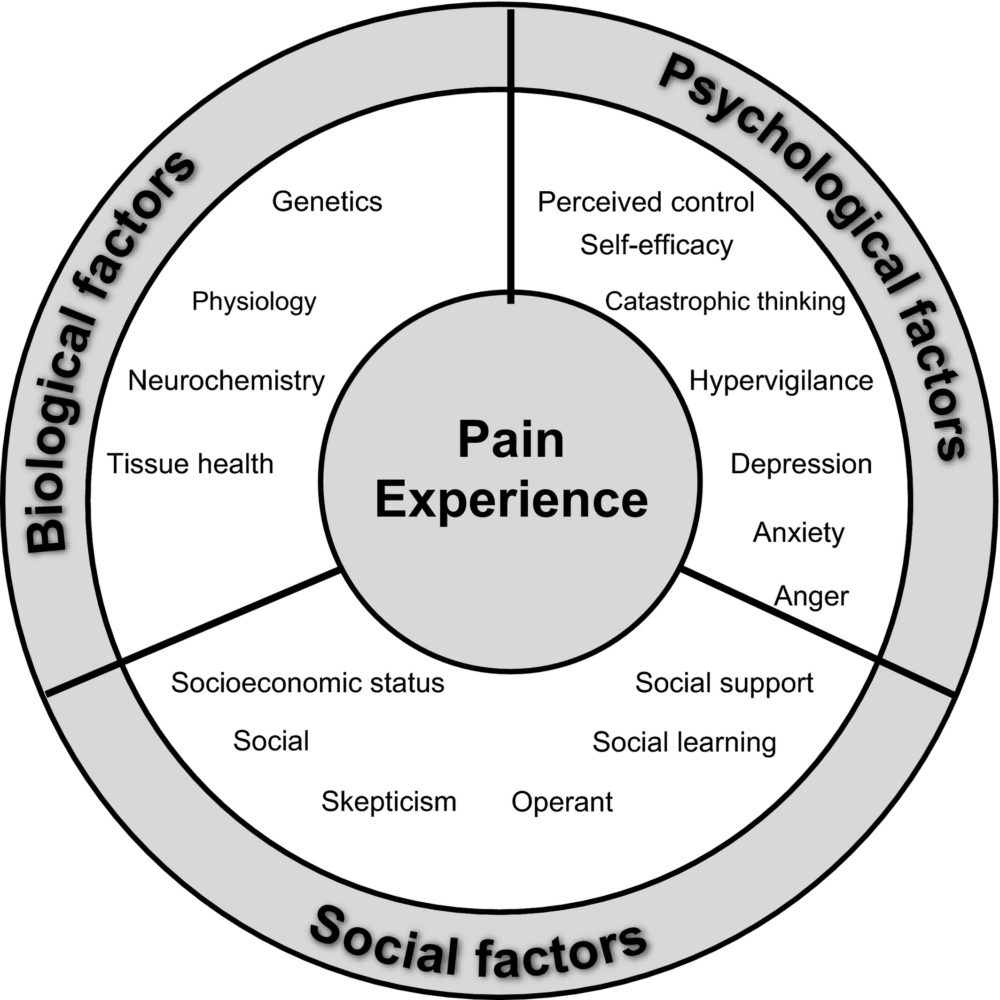
Precision Pain Care & Rehab. (n.d.). All You Need to Know About Musculoskeletal Pain. Precision Pain Care & Rehab. Retrieved April 7, 2025, from https://www.precisionpaincarerehab.com/blog/all-you-need-to-know-about-musculoskeletal-pain-20316.html