
A good assessment is paramount for any athlete. An FRA®, in addition to other baselines that providers find value in, can be a great way to establish a specific starting point. If you’re unfamiliar with an FRA®, it evaluates every single joint from head to toe. The findings help inform training decisions. If you haven’t had your joints assessed, there is often a lot of low-hanging fruit athletes can start working on immediately to improve their joint capacity—a fundamental pillar of health and longevity. Once baseline joint health is established, it can be referred back to, reassessed, and built upon to better understand an athlete’s physical state over time.
In the CARs portion of the FRA® assessment, there is a critical opportunity to emphasize that the quality of the sensory feedback athletes develop is partly a learned skill—like a musician learning to recognize what key a song is being played in, their ear is trainable. The feedback your tissues provide is no different. Your body is constantly giving you signals during CARs practice. As you continue practicing, you become better at recognizing and categorizing sensations: pain, discomfort, pinching, burning, and more. Everyone starts with a different level of sensitivity, but consistent, high-quality practice helps you extract clearer feedback that you can use yourself and communicate more effectively to a provider. That is a powerful tool you have from day one, though its value isn’t immediately appreciated
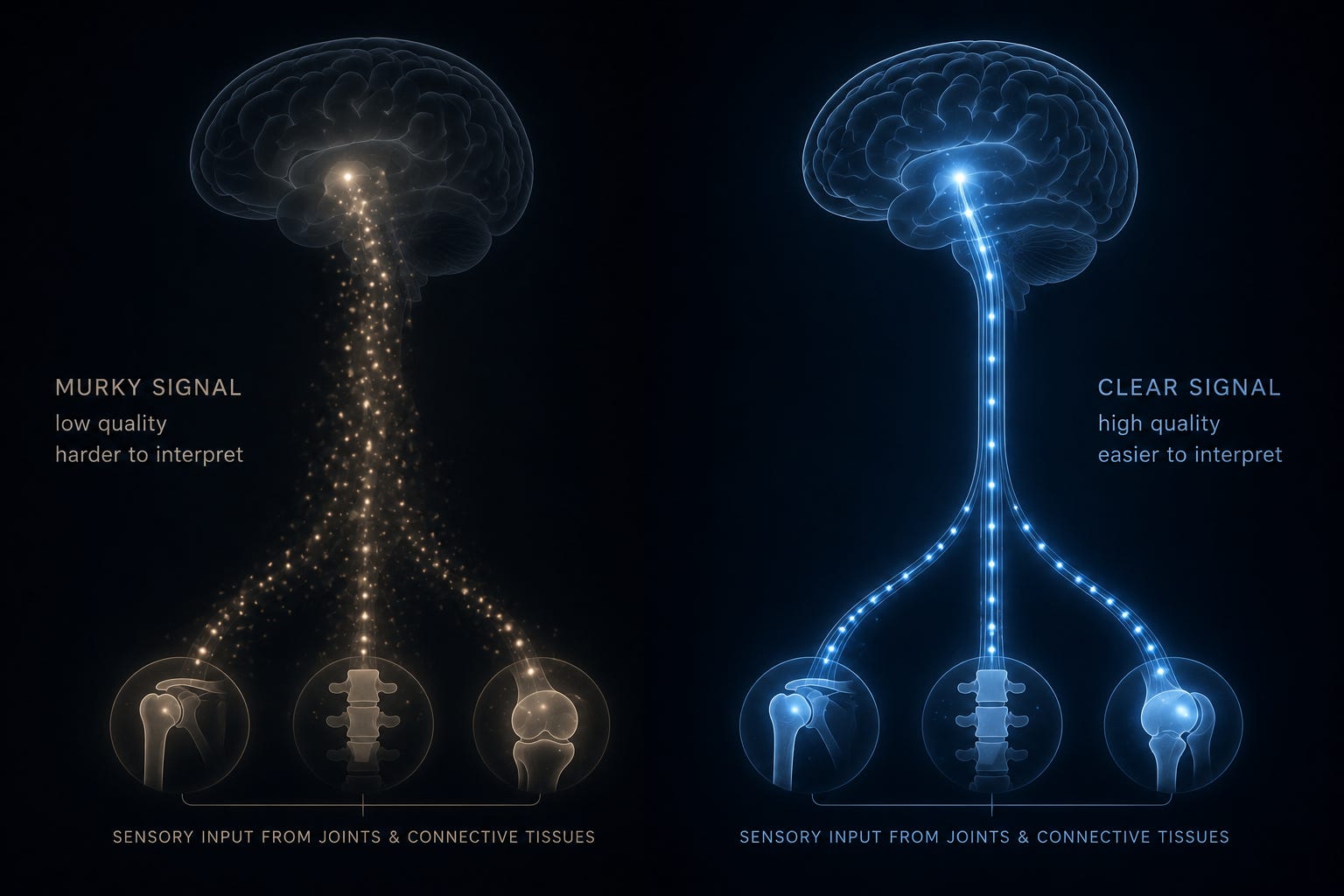
(visual oversimplification of afference to help visualize the concept)
Contrast this with the inability to interpret certain sensory signals. There is an extremely rare group of congenital conditions, often referred to as CIP (congenital insensitivity to pain), in which individuals cannot perceive pain because of disrupted nociception. This is not something that can be trained. That capacity is absent, making painful stimuli dangerous precisely because there is no protective feedback (imagine not feeling your skin burn, a bone break, or a deep cut).
When it comes to the sensory input coming from joints and connective tissues as they move through space and manage force, that system is highly adaptable. You can improve the quality of that input from whatever your baseline happens to be. The quality of each repetition matters because every CAR is another opportunity to refine how your nervous system detects and interprets those signals. Over time, this changes both how you perceive your own body and how effectively you can communicate those observations to a provider. This cannot be overlooked when educating an athlete. They need to understand both how to build better tissue feedback and why deliberate practice improves their ability to interpret it. Too often, this is a missing piece in early education. It is ultimately the responsibility of providers to teach these concepts, giving athletes more agency and setting better expectations from the outset.
If you are a provider who isn’t having regular conversations about afferent information and what it is, this is your reminder. If you are an athlete reading this, consider this a simple introduction to something you can actively cultivate. If you or someone you know would like a great place to start, check out my intro and foundations class.