
There are two kinds of athletes: those who assume that doing an exercise—or a “special” exercise—will build the capacity it’s named after, and those who see the oversimplification.
Here’s the problem: your body is incredibly good at completing exercises. So good, in fact, that it will quietly borrow range from other joints and tissues to make the intended movement happen—even when the joints doing the work don’t actually have the capacity to do so. And these limitations don’t always announce themselves. You often don’t feel them until they become problems.
You think you’re training a capacity. You’re actually reinforcing a workaround.
Movement Is Like a First Draft
Movement is like a first draft in writing. Just because you put words on paper doesn’t mean they’re any good. Similarly, just because you extended your hip in a squat doesn’t mean you did it with sufficient quality or range for your goals.
Your perception of hip extension may be flawed. Complex movements like squats are easier to cheat through compensation than isolated, prerequisite ranges. If you only looked at the outcome—it feels or looks like you extended your hip because you squatted or ran—you’re assuming the independent quality and quantity of hip extension must have been good. But that’s like assuming your first draft is publication-ready because you finished writing it.
We have to separate movement quality from skill development. Practicing squats or running repeatedly is not the same as training the quality of the parts you bring to that practice. Just as editing improves a draft, isolating and refining movement prerequisites improves the movements you build on top of them.
The Parts That Matter
What role do the parts play in movement? By parts, I mean your joints. These are some of our deepest structures—defined by the space between two bones, how much movement exists there, and how well you can control it. Yes, both are trainable. And they influence all the important connective tissues and muscles layered on top.
Field sport athletes need hip extension. Most of them train it via exercises. But if your hip doesn’t truly extend—if your lumbar spine is extending, your pelvis is tilting, your opposite hip is compensating—then every hip extension exercise you do is just reinforcing the pattern your body already defaults to. You’re not building the capacity. You’re getting better at faking it.
Here’s the thing: those skills, no matter how elite, are being honed with a compensating hip. Over time, that comes at a cost.
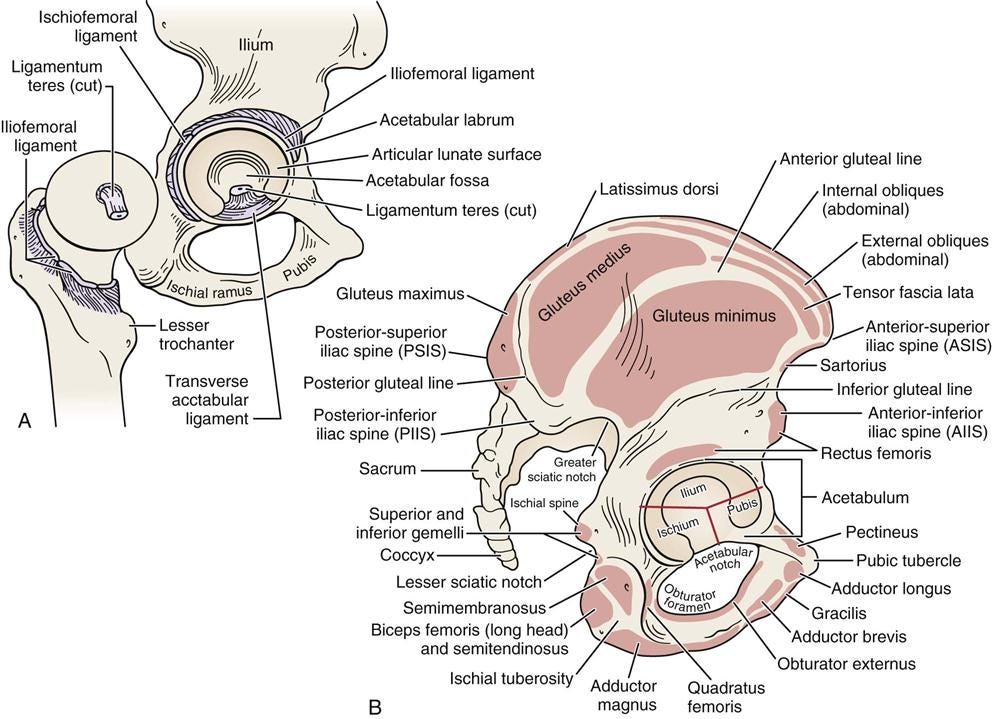
(image from https://musculoskeletalkey.com/hip-3/)
Hip extension is not one thing. It’s joint range. Earning control through that range is not a given—it’s specifically trained. As are the behaviors you need there: stiffness, force absorption, speed. These are distinct qualities you can train and build separate from practice. They require distinct inputs. And none of them develop simply by doing more of an exercise that assumes the capacity is already there.
So the real question isn’t “how many hip extension exercises do I need?” It’s “do I actually have a hip that extends in the first place? And if not, how do I improve that, specifically?”
Most people never ask that question. They add reps, add load, add variations—all of which can compound the compensation rather than address it directly.
The Solution: Prerequisites First
So if compensation is the problem, what’s the solution?
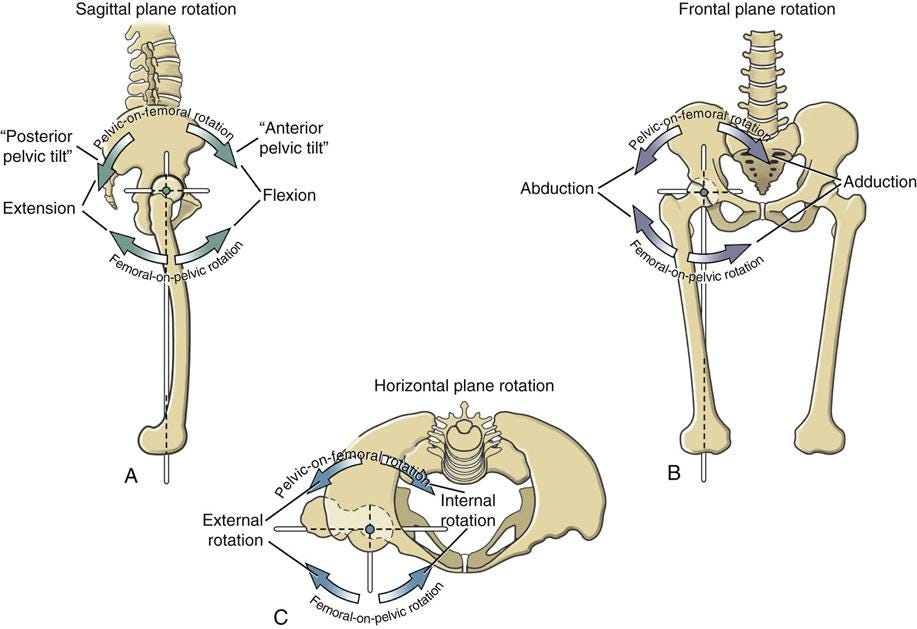
It starts with understanding prerequisite capacities: how much space you have to move your joints, the quality of that range, and the training needed to improve specific tissue demand. These are three distinct things.
(image from https://musculoskeletalkey.com/hip-3/)
First: The joint has to move independently.
Before anything else, the hip has to express fundamental rotational motion—it’s a ball and socket joint. Extension needs to be assessed on its own. Not as part of a loaded movement. Not within a complex pattern.
This is the prerequisite most training skips entirely. Because the athlete can complete the movement, the assumption is that the capacity is there. But completion and joint-specific ownership are not the same thing. A hip that borrows range from the lumbar spine or pelvis to finish a rep has not demonstrated hip extension. It has demonstrated a compensation that looks like hip extension.
Until the joint can express the motion independently, everything built on top of it is built on compensation.

Second: Extension isn’t one position—it’s a zone.
Extension isn’t a single endpoint you either have or don’t have. It’s a zone range within which different tissue qualities and capacities can exist. An athlete might own part of that zone but have no access to other parts they need. Or they might have plenty of passive range in a zone but can’t actively control it.
A field sport athlete who needs explosive hip extension in multiple zones—under load and at speed—can help their hip perform better by training the specific portions of the zone they lack. Training around it doesn’t develop it. Jumping into more practice doesn’t magically ‘unlock’ those zones.
Third: You can’t scale tissue demand without first owning your zones.
Sport-specific tissue work—building speed, connective tissue stiffness, force absorption—has to be placed in specific tissues, not just complex exercises where compensation may be the default. If the athlete doesn’t independently own the zone where that tissue demand needs to land, you aren’t loading the target tissue in the target position. You’re loading whatever tissue is available to compensate.
This is why athletes can do years of sport-specific training and still have the same limitations. The training was well-intended. The effort was there. But the prerequisite capacity was never established first, so the tissue demand was always set up to land wherever capacity existed — not where it needed to be built.
Prerequisites are the foundation to scale a lot of training potential. Skip them and you’re not just missing out on gains—you may be training your body to compensate better, which may eventually show up as pain, injury, or performance plateaus that no amount of “hard work” will fix.
The good news? There are solutions exactly for these kinds of problems.
Found this helpful? Share it with someone who’s been grinding through the same exercises without getting different results. Or check out over a dozen free articles I have right here on this substack.
Want to dive deeper? Book a session at www.theartofstrong.com or take a course with Functional Range Systems® at www.functionalanatomyseminars.com.